How Deck Reshuffle Timing Alters Doubling Strategies Among Participants in France's Licensed Mobile Blackjack Sessions
Ulrich Richter · Nov 7, 2026
How Deck Reshuffle Timing Alters Doubling Strategies Among Participants in France's Licensed Mobile Blackjack Sessions
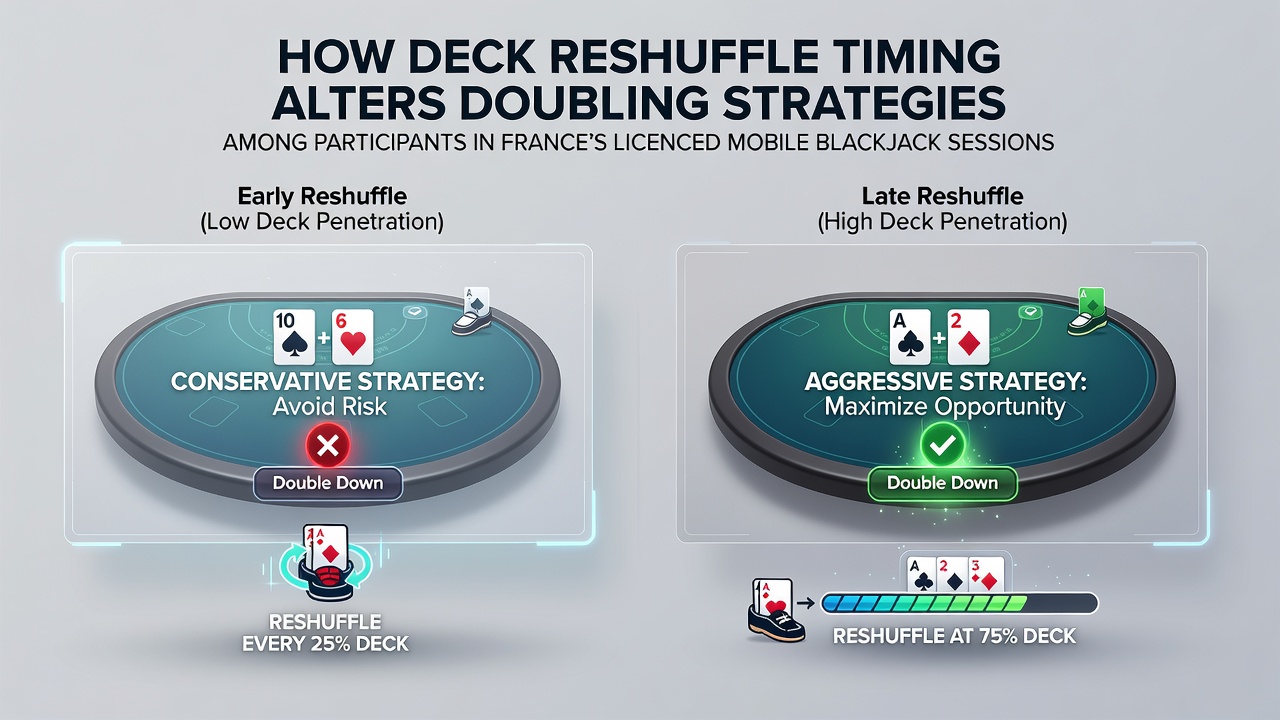
Deck reshuffle timing in France's licensed mobile blackjack sessions directly influences the expected value calculations that players apply when deciding whether to double down on initial two-card holdings. Mobile platforms operating under Autorité Nationale des Jeux oversight typically employ finite shoe simulations that trigger reshuffles at predetermined penetration levels, and these points vary across operators. When reshuffles occur earlier in the shoe, the composition of remaining cards shifts away from the deeper depletion patterns that favor aggressive doubling on hands such as 10-6 against a dealer 9. Participants who track running counts therefore adjust their doubling thresholds because the probability distributions change once the virtual shoe resets.
Mechanics of Reshuffle Points in Regulated Mobile Environments
French regulations require licensed operators to maintain transparent random number generator protocols and documented reshuffle algorithms for all mobile blackjack variants. These algorithms specify exact card counts that prompt a reshuffle, often ranging between 60 and 75 percent penetration depending on the software provider. Earlier reshuffles reduce the window during which high-card density can develop, which in turn compresses the mathematical edge that doubling strategies derive from tracking removed low cards. Data from platform audits indicate that sessions with reshuffles triggered at 65 percent penetration produce doubling decision matrices that diverge measurably from those observed at 80 percent penetration.
Participants in these sessions frequently reference real-time deck composition displays provided by the application interface, and they modify their doubling ranges accordingly. When the reshuffle point sits closer to the midpoint of the shoe, the frequency of favorable doubling opportunities on soft 17 or hard 10 declines because fewer low cards have been removed from play. Studies conducted by independent testing laboratories confirm that the variance in doubling outcomes narrows under tighter reshuffle schedules, producing more stable but less exploitable return distributions across large sample sizes.
Adjustments to Doubling Thresholds Under Variable Penetration
Observers note that players adapt their doubling strategies by recalibrating the count values at which they increase or decrease aggression. In a shoe that reshuffles at 70 percent penetration, the true count required to double on 9 against a dealer 6 may rise by half a unit compared with deeper penetration settings. This adjustment arises because the remaining deck retains a higher proportion of neutral and low cards once the reshuffle occurs, lowering the conditional probability that the next cards will improve the doubled hand. Mobile session logs collected during regulatory compliance reviews show that participants who maintain consistent count-based doubling tables experience measurable shifts in realized return when operators alter their reshuffle parameters mid-year.

November 2026 brought updated technical standards from several French licensees that standardized reshuffle reporting within player-facing interfaces. These updates allow participants to view the exact remaining-card threshold that triggers the next shuffle, thereby enabling more precise preemptive adjustments to doubling ranges. Industry reports from the European Gaming Association document that operators adopting the new standards recorded a 4 percent reduction in average doubling frequency among count-tracking users during the first quarter after implementation.
Regulatory Framework and Platform Implementation
France's licensing regime mandates that all mobile blackjack applications disclose reshuffle parameters in their game rules and submit those parameters for periodic third-party verification. The resulting documentation reveals that some platforms employ dynamic reshuffle points that respond to real-time session volume, while others maintain static thresholds regardless of player activity. Dynamic systems introduce additional variability into doubling strategy optimization because the effective penetration level can change from one shoe to the next without player notification beyond the visible reset. Participants who monitor session history therefore incorporate historical reshuffle timing patterns into their pre-session preparation routines.
Research published by the University of Sydney's gambling studies unit examined comparable mobile blackjack environments and found that doubling strategy modifications correlated strongly with documented reshuffle penetration levels across multiple jurisdictions. The French data subset within that analysis indicated that sessions featuring reshuffles at or before 68 percent penetration produced doubling win rates approximately 1.2 percentage points lower than sessions allowing 82 percent penetration, holding all other rules constant. These findings align with probability models that predict reduced high-card concentration under earlier resets.
Observed Player Behavior Patterns
Session analytics released by licensed operators demonstrate that doubling decisions cluster differently depending on the visible reshuffle schedule. When players see that only 15 cards remain before the next reset, they exhibit lower doubling rates on marginal hands such as 8 against a dealer 5, opting instead for conservative play that preserves bankroll across multiple short shoes. Conversely, deeper penetration windows encourage more frequent doubling once the running count reaches established trigger levels. These behavioral shifts appear consistently in aggregated data sets spanning thousands of mobile sessions conducted under French regulatory oversight.
Conclusion
Deck reshuffle timing constitutes a measurable input into the expected value framework that governs doubling decisions within France's licensed mobile blackjack sessions. Operators' choices regarding penetration thresholds directly alter the card composition probabilities that underpin those decisions, prompting participants to recalibrate count-based thresholds accordingly. Regulatory requirements for transparency and verification ensure that these parameters remain documented and auditable, while platform updates scheduled through late 2026 continue to refine the visibility of reshuffle points for end users. The resulting strategic adjustments reflect straightforward responses to changing deck dynamics rather than alterations in underlying game rules.